
By James Dalebozik, MSM, CD
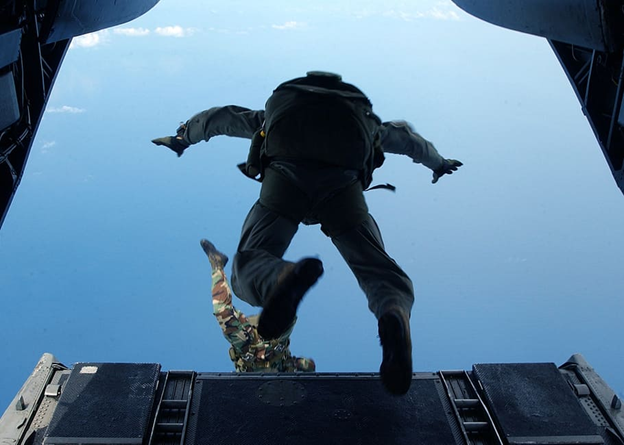
High Altitude Parachute Drops have become a core capability for advanced Special Forces operations, enabling personnel and equipment to be deployed from altitudes exceeding 30,000 ft. These techniques allow aircraft to remain outside contested airspace or above the reach of surface-to-air defence systems, enabling covert insertion methods such as HAHO/HALO parachuting, aerial delivery, and reconnaissance missions.
Despite extensive training and the use of preventative measures such as pre-oxygenation, exposure to reduced atmospheric pressure at altitude presents an unavoidable physiological risk. One of the most serious of these risks is Altitude Related Decompression Sickness (DCS), which can affect aircrew, pilots, and deployed personnel alike.
What Is Altitude Decompression Sickness?
Decompression Sickness occurs when inert gases, primarily nitrogen, come out of solution within body tissues due to a rapid or sustained reduction in ambient pressure. This can result in bubble formation within tissues and blood vessels, leading to symptoms ranging from joint pain and sensory disturbances to severe neurological impairment, respiratory distress, and, in extreme cases, circulatory collapse.
Contributing Factors at Altitude
Altitude itself is the primary risk factor for DCS, with bubble formation commonly occurring above 18,000 ft, though cases have been reported below this level. Studies involving military and aviation personnel demonstrate that even with oxygen pre-breathing protocols, the incidence of DCS remains significant, particularly at altitudes above 22,000 ft and during physically demanding operations.
While military and civilian diving operations operate under strict proximity requirements to hyperbaric treatment facilities, no equivalent universal standard has historically existed for high-altitude aviation and airborne operations. As a result, DCS remains an operational risk that must be planned for rather than assumed to be fully preventable.
Mitigation and Operational Preparedness
Standard risk reduction strategies include pre-oxygenation with 100% oxygen prior to ascent and continued oxygen use during high-altitude exposure to reduce tissue nitrogen levels. NATO guidelines require de-nitrogenation before ascending beyond 16,000 ft when operating above 18,000 ft.
While these measures reduce the likelihood of DCS, they do not eliminate it. Operational planning must therefore include realistic response capabilities for managing DCS when it occurs, particularly in remote or austere environments.
SOS Review: Operational Effectiveness of the Hyperlite 1
A case study published by the United States Air Force highlights the operational value of portable hyperbaric treatment systems in addressing altitude-related decompression sickness. During high-altitude training operations in Alaska, a physically fit aircrew member developed symptoms consistent with neurological DCS despite full compliance with preventative protocols.
Under normal circumstances, definitive hyperbaric treatment would have required long-range medical evacuation to a fixed hyperbaric facility, involving significant cost, time delays, and additional risk to the patient. Instead, treatment was successfully administered on-site using a portable hyperbaric stretcher system — the SOS Hyperlite 1.
This case demonstrates several critical operational advantages of the Hyperlite 1:
Immediate access to definitive treatment without reliance on long-distance evacuation
Reduced risk of symptom progression associated with unpressurised or delayed transport
Operational flexibility in remote or resource-limited locations
Cost and time efficiency compared to traditional aeromedical evacuation
The successful outcome reinforces the role of compact, modular hyperbaric systems as a practical and effective solution for managing altitude-related DCS during modern high-altitude operations. Rather than serving solely as contingency equipment, portable hyperbaric chambers such as the Hyperlite 1 are increasingly viewed as essential components of mission medical planning.
Conclusion
As high-altitude airborne operations continue to expand in scope and frequency, decompression sickness remains an inherent operational risk. The integration of portable hyperbaric treatment systems offers a proven, field-ready solution that bridges the gap between preventative measures and definitive care. The Hyperlite 1 exemplifies how adaptable medical capability can significantly enhance mission safety and operational resilience.