
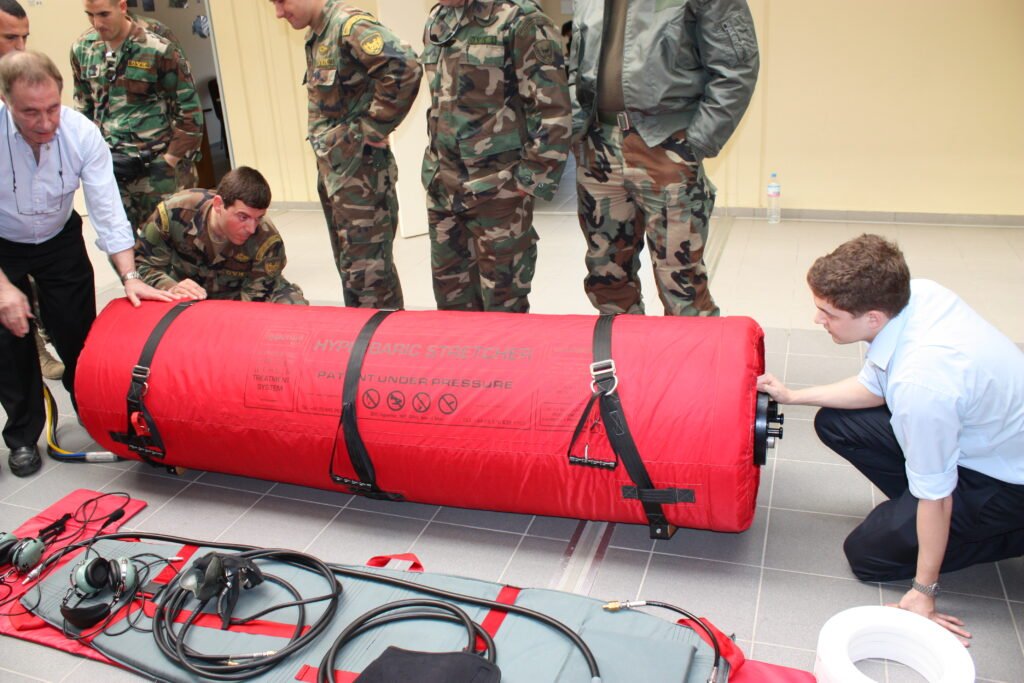
Portable hyperbaric stretchers are often perceived as niche equipment, typically associated with military or diving operations. However, growing research and operational experience suggest that these systems may have far wider relevance across civilian rescue, aeromedical, and disaster-response environments—particularly where evacuation times to advanced medical facilities are prolonged.
Modern deployable hyperbaric chambers function as pressurised stretchers, allowing casualties to receive oxygen therapy in a controlled, elevated-pressure environment from the point of injury through transport to definitive care.
Expanding the Role of Hyperbaric Care
Hyperbaric treatment has existed for decades, historically delivered via large, fixed steel chambers primarily used to treat decompression sickness. What has changed is not the therapy itself, but the ability to deliver it at the frontline.
Recent military research and field use indicate that early exposure to pressurised oxygen may offer physiological benefits in a range of emergency scenarios. These benefits stem from improved oxygen delivery to tissues and organs under stress—particularly relevant in trauma, hypoxia, and neurological injury.
Although hyperbaric stretchers are not yet commonplace in civilian emergency services, their potential role in prolonged evacuation scenarios is increasingly recognised.
Potential Clinical Applications
Based on published research and operational experience, portable hyperbaric stretchers may be considered in scenarios including:
-
Neurological injury, including blast-related trauma
-
Major wounds where enhanced oxygenation may support healing
-
Smoke and carbon monoxide inhalation
-
Decompression and altitude-related illness
-
Hypovolaemia and shock
-
Mild traumatic brain injury (mTBI)
-
Crush injuries
While not all applications are yet standardised, the growing body of evidence suggests that hyperbaric oxygen therapy may act as a valuable adjunct during transport when definitive care is delayed.
Operational Context and Limitations
In many emergency scenarios—mountain rescue, offshore operations, disaster zones, and rural incidents—time to a fully equipped medical facility can be significant. Even where hospitals are well resourced, access to hyperbaric chambers capable of treating trauma is often limited.
Portable hyperbaric stretchers address this gap by enabling treatment to begin immediately and continue throughout evacuation, rather than waiting until arrival at a fixed facility. This capability represents a shift from static to mobile hyperbaric care.
As with any specialist equipment, cost, training requirements, and integration into existing response models remain considerations. However, these factors must be balanced against the potential to improve outcomes in high-risk, time-critical cases.
SOS Review: Operational Perspective on Deployable Hyperbaric Stretchers
From an SOS standpoint, deployable hyperbaric stretchers represent a significant advancement in pre-hospital and transport medicine.
The SOS Hyperlite 1 was developed to meet demanding military requirements, including portability, durability, and compatibility with air and ground transport platforms. Independent military evaluation programmes demonstrated that the system could operate safely in deployed environments and during aeromedical transport.
Key operational considerations highlighted through field use include:
-
Early intervention: Hyperbaric treatment can begin immediately rather than being delayed until arrival at a fixed facility
-
Reduced evacuation risk: Maintaining a controlled pressurised environment avoids additional physiological stress during transport
-
Portability: Lightweight composite construction enables deployment by small teams across multiple platforms
-
Flexibility: Suitable for military, civilian, and humanitarian operations in remote or austere locations
While initially adopted to support battlefield trauma and decompression-related incidents, the system’s design allows it to be applied more broadly wherever prolonged evacuation and hypoxia-related injury are concerns.
Civilian and Emergency Service Relevance
Many injury patterns encountered in military operations closely mirror those seen in civilian emergencies, including industrial accidents, fires, terrorist incidents, and natural disasters. As such, the potential benefits of deployable hyperbaric capability extend well beyond defence applications.
Air ambulance and search-and-rescue platforms are particularly well suited to deploying portable hyperbaric stretchers, enabling early treatment close to the scene and continuous therapy during transport.
As awareness grows and technology continues to evolve, portable hyperbaric systems are increasingly viewed not as niche equipment, but as a strategic medical capability for selected high-risk scenarios.
Conclusion
Portable hyperbaric stretchers represent an evolution in how hyperbaric oxygen therapy can be delivered—moving treatment closer to the point of injury and maintaining it throughout evacuation. While traditionally associated with decompression sickness, their potential application across trauma, inhalation injury, and neurological insult is gaining recognition.
Deployable systems such as the SOS Hyperlite 1 demonstrate how mobile hyperbaric capability can enhance medical response in environments where time, distance, and access to specialist care are critical limiting factors.
Source: Technical Rescue magazine, editorial feature on deployable hyperbaric stretchers, by Scott Selby (Editor), © Technical Rescue.